An Illustration of Significant Figures, Accuracy, Precision and Data Analysis
Objective: To introduce some fundamental techniques for measuring mass and volume and to learn to apply the rules of significant figures.
Discussion:
In science, it is extremely important to be able to
make measurements correctly. Reliable measurements allow for factual
knowledge about the world to be expressed clearly and concisely. Almost
all scientific studies involve some kind measurement. As you continue
your studies in chemistry and science you will learn by performing
experiments, that important
properties of matter, such as density, depend on specific measurements.
Numbers and Measurement.
There are two general categories of numbers:
Exact numbers: numbers of absolute accuracy, having infinite precision
Measured numbers: numbers of finite accuracy with limited precision
Exact numbers are absolute values because
there is no uncertainty in the value. For example, counted numbers are
exact numbers: the number of people in your lab section or the number
of fingers on your hand. Defined numbers such as 12 inches per foot, 16
ounces per pound are also exact numbers. To say there are 28.5 people
in your lab section is meaningless. Anything other than 16 ounces is
not a pound. These are exact numbers. The accuracy and precision of any
calculation does not depend on exact numbers. Measured numbers are the
numbers that are determined by a measurement during an experiment. For
examples measured numbers can be the length of a material measured by a
linear scale, or the mass of a substance measured by a balance. Several
measurements should be made to verify measured numbers. The accuracy of
a measured number is calculated from the average of the measurements,
how close the average is to the “true value”. In the absence of a
determinate error, or systematic error, the accuracy of a group of
measurements should be very high. The precision of a measurement
depends upon the uncertainty of the individual measurements. The
precision of a measured number may be large if the measured values
vary, but the accuracy could be very high if the average comes close to
the “true value”. On the other hand, the precision of a measured number
may be small if all the measurements have similar values, but the
accuracy could be very low if the average of those similar numbers is
far from the “true value.”
Every
measurement has two parts: the numerical value and the unit. Both must
appear when quoting or recording a measurement. The numerical value
provides the accuracy of the measurement while the unit tells us the
dimension or property which has been measured. Without both parts, the
unit and the value, the measurement can be confusing or meaningless.
Measurement
and the 10% Rule. The number of significant figures (SF) in a
measurement always includes one estimated digit when reading the
measured value on a calibrated scale. We include one estimated digit
because it is standard practice in making a measurement to complete the
measurement by reading or estimating 0.1 times (or 10%) of the
calibrated separation between the nearest adjacent calibrations of
the measuring device. The estimated digit represents the uncertainty of
the measurement. When reading the measurement on a digital output, the
instrument will usually list the uncertainty of the instrument. For
example, a milligram balance could present the measurement of 8.097 g.
It is assumed that the uncertainty
is +/- 0.001 g, an uncertainty of +/- 1 for the last digit.
Volume Measurements.
The
volume of a sample is the total amount of space occupied by the sample.
When cooking, liquid volumes are measured in units of teaspoons,
tablespoons and cups. In the laboratory, liquid volumes are typically
measured by using graduated cylinders or volumetric glassware. Such
glassware is read by observing the bottom of the meniscus level of
the liquid and reading to 0.1 times (the 10% Rule) of the smallest calibrated mark.
Mass Measurements and Weight
Mass is measured in the laboratory by using a balance.
Electronic balances can be tared when performing mass
measurements. To tare a balance means to set the display equal to
zero while the container is on the balance. Then the mass of the matter
being weighed can be directly read from the balance, without having to
subtract the mass of the container.
Average Results and Standard Deviation
Consider a set of valid experimental results. Set means a group
of results which are related in that each result refers to the same
quantity. Valid means that each result is acceptable and has been
obtained by performing measurements correctly within the limits of the
experimental accuracy. Rather than report the entire set of values, we
prefer to report the average result for each set. The average result is
the sum of all individual results in the set divided by the number of
results.
Before lab, you must be familiar with how to
calculate averages and standard deviations (SD). Standard deviation is defined
as
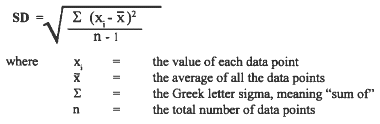
In brief, here is what you do. Calculate
the average of your set of data points. Then take one data point, and
subtract its value from the average. Then square that 'difference'.
Take that number and put in a 'box'. Now take another data point,
subtract it from teh average and square that difference. Put it in the
box. Repeat for all the other data points.Now, take all those numbers
in your box and add them together (that is what the sigma is for) and
divide by n-1. Take the square root of that bohemoth and you have your
S.D.
Here is one site with a nice
description what SD is and (at the bottom) how to calculate it. Another
The Penny
From 1959 through to 1981, the U.S. Mint produced more than 130 billion
pennies. Then, in 1982 the Mint introduced a penny that is 97.6 percent
zinc and only 2.4 percent copper with a density of 7.2 g/mL. By
comparison, the old pre-1982 copper pennies were 95 percent copper and
5 percent zinc with a density of 8.8 g/mL. The copper-plated zinc penny
is identical in size and appearance to its copper-rich counterpart, but
the current cent is 19% lighter.
The Experiment
In this experiment, you will determine the density of
individual coins as well as a group of coins. The masses will be
measured with analytical balances. The volume of individual coins and
the group must be done by two different methods. This will give a total
of 8 different groups of densities for you and your lab partner.
( 5x individual old pennies ) x 2 Volume methods
one group of 10 old pennies x 2 Volume methods
( 5x individual new pennies ) x 2 Volume methods
one group of 10 new pennies x 2 Volume methods
You will then calculate the average density of a single
penny from the 8 methods. You will also calculate and report the
standard deviation of the two sets of individual 5 coin measurements.
Questions to be answered in your report (typed)
no need to re-write the question, simply label the answer with question #'s.
1)
Compare the volume and average density that were measured for the stack
of ten pennies by linear measurement and displacement methods for both
old and new pennies. Which method gave a larger value?
2) By
comparing to the actual density, which method, dimensions or
displacement, gives a more accurate measurement of the density of the
penny? Why?
3) Check all of your results with at least two other groups. Were your averages comparable? Explain
4) Which method is more accurate, the stack of ten pennies or individual pennies? Why?
5) Which method is more precise, the dimensions or the displacement? Why?
6) Which method is more precise, the stack of ten pennies or individual pennies? Why?
7) Comment on the measuring devices used in this experiment and how they effected the accuracy or precision.
8) Using 'fifth grade' language, define accuracy and precision using this experiment as a reference.
9) Give 2 suggestions to make this a more effective learning experience.
Lab Report
Your computer generated
lab report (no hand written) will consist of the answers to the above
questions as well as a well labeled and understandable computer
generated (Excel?) table with all your individual data points as well
as densities and SD calculations. You must include only ONE sample
caluclation of each calculation in your report. So, show me (in gory
detail) one of your S.D. calculations. For the rest, just give me what
the S.D. actually is. You sample calculations CAN BE hand written, but
only calculations are allowed to be hand written. This rule goes for
ALL lab reports.
Pre-lab questions (on recycled paper)
1. Is the assumption that a penny has a regular shape (all sides flat) valid?
2. What is the average and standard deviation of the
following data set: 3.4 cm, 3.7 cm, 3.2 cm, 3.9 cm, 3.1 cm, 3.4cm ? Show your
work and be detailed in showing your method. Do NOT simply put the data in your
calculator and give me the final result.
3. As a coins gets 'older' what do you expect to
happen to the mass of the coin? There is no right/wrong answer. Defend/explain
your answer.